
Stopping Water from Running Down Your Back into the Backpack: A Field-Tested Guide
It’s mile 14 of a 3-day route in the Cascades. The rain started an hour ago, and you’ve just realized the inside of your pack is soaked — your sleeping bag, your fire kit, your extra base layer. All wet. You’ve got one night left, temperatures dropping to 40°F, and hypothermia is no longer an abstract concept. This is when stopping water from running down your back into the backpack stops being a gear preference and becomes a survival priority.
I’ve been in that situation. I’ve pulled clients out of it, too. And every single time, the problem started with something preventable.
| Method | Effectiveness | Failure Mode | Best For |
|---|---|---|---|
| Rain Cover (pack-specific) | High (outer shell) | Gaps at shoulder straps let water funnel in | General rain protection |
| Pack Liner (dry bag inside) | Very High (inner seal) | User forgets to roll seal properly | High-stakes wet environments |
| Neck/Collar Seal (rain jacket) | Medium (redirects flow) | Jacket collar gaps, water channels down spine | Short exposures, moderate rain |
| Backpack Rain Skirt/Collar | High (blocks entry point) | Rarely included, often DIY required | Eliminating the back-channel gap |
| Drysack Compartmentalization | Very High (per-item) | Time-consuming to pack correctly | Critical gear protection |
| Seam Sealing the Pack | Medium-High (longevity) | Wears off, must be reapplied seasonally | Older packs, budget setups |
Use this table as your decision matrix. Each row represents a real layer of defense. The most resilient hikers I’ve guided use at least two of these simultaneously. The ones who suffer use one — and assume it’s enough.
Why Water Runs Down Your Back in the First Place
Water follows physics. Your spine is a gutter. When rain hits your head, jacket hood, and shoulders, it channels directly into the gap between your back and your pack’s top opening — every single time.
The anatomy of the problem: your rain jacket sheds water downward. The pack sits against your lower back. That gap between your jacket collar and the top of the pack is where every raindrop on your upper body eventually arrives.
Pack designers know this. Most just don’t solve it at the hardware level.
What most people don’t account for is movement. When you hike, your jacket rides up slightly, your pack shifts, and the gap opens and closes rhythmically — pumping water in like a bellows. I’ve seen a perfectly rain-covered pack with a fully soaked interior because of this one mechanical reality.
Stopping Water from Running Down Your Back into the Backpack: The Layered Defense System
No single solution works in sustained heavy rain. The effective approach is a layered system that addresses the outside, the entry point, and the inside of the pack independently.
Layer one is your rain cover. Fit matters more than brand. A cover that’s too large billows in wind and creates pooling. Too small and it doesn’t reach the shoulder strap exit points. REI’s guide on pack rain covers breaks down sizing properly — read it before you buy. The cover should sit flush against the pack’s base with no air gaps.
Layer two is the entry point seal. This is where most guides stop. They don’t address the actual channel — your back.
Here’s the field fix I use: tuck the back panel of your rain jacket into the top of your pack’s main compartment opening, or use the pack’s top collar if it has one. Some packs — Osprey Atmos, Granite Gear Crown series — have a collar extension that functions like a gasket. If yours doesn’t, a simple loop of shock cord threaded through the jacket’s hem and clipped to the pack’s top loop redirects flow outward instead of inward.
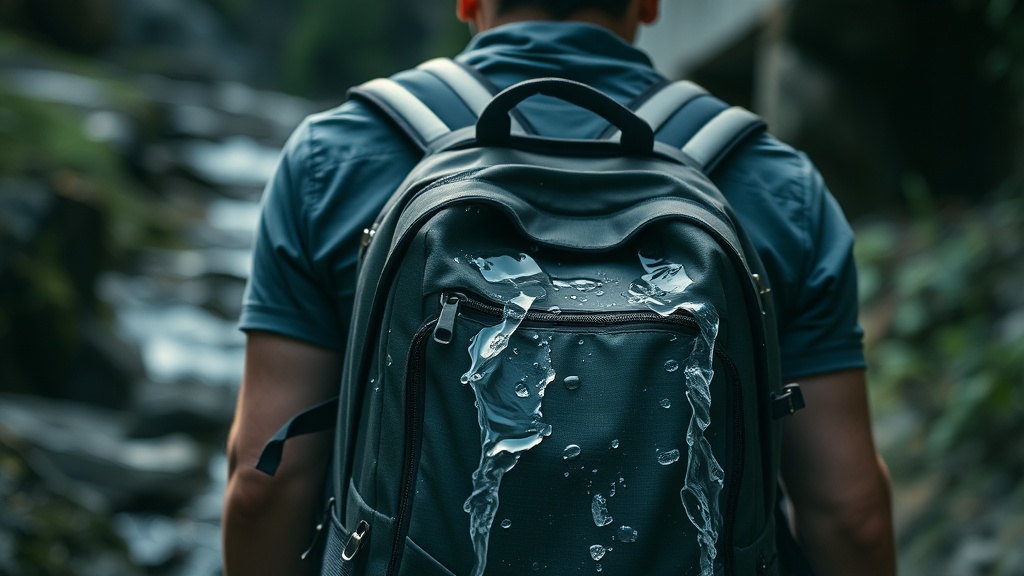
Layer three is the pack liner. A 30-liter dry bag inside a 38-liter pack is your last line of defense. Roll the seal three times minimum — not two, three. I’ve seen a double-rolled liner fail on a river crossing. Three rolls gives you the geometry you need for a proper seal.
The pattern I keep seeing is hikers who invest in an expensive waterproof pack and skip the liner entirely. Waterproof fabrics degrade. Zippers leak. Seams fail over time, especially with heavy use. A $15 dry bag liner is cheap insurance that doesn’t rely on your pack’s aging materials.
The Gear That Actually Addresses the Back Gap
A small category of products specifically targets the spine-to-pack gap — most hikers have never heard of them, but they’re worth knowing.
Pack rain collars — sometimes called pack rain skirts — are neoprene or silicone gaskets that wrap around the top opening of your pack and seal against your jacket or back panel. They’re uncommon in retail, but Backpacker Magazine’s waterproofing breakdown references a few DIY approaches that work on the same principle.
The DIY version I teach in WFR field courses: cut a section of closed-cell foam into a crescent shape. Attach it with shock cord to the top of your pack’s main collar. It creates a physical deflector that pushes jacket runoff away from the opening. Not elegant. Completely effective.
What surprised me was how few pack manufacturers have addressed this despite it being a decades-old problem. The market has a gap. Until they close it, field engineering is your best option.
Clothing Adjustments That Redirect Water Flow
Your clothing system plays a direct role in how much water enters your pack — adjusting it costs nothing and takes 30 seconds.
First: hood management. A proper storm hood cinched tight at the face creates a brow channel that diverts water sideways — away from your neck and collar gap. A loose hood is a funnel aimed directly at your spine.
Second: your jacket collar. Raise it fully, even if it feels warm. The collar is the last physical barrier before water hits your neck and slides down your back into the pack. I hike with mine up at all times in precipitation, regardless of temperature.
Third: consider a pack poncho rather than a jacket in sustained heavy rain. A poncho covers both you and the top of your pack in one system, eliminating the back gap entirely. I’ve seen this work better than any combination of jacket-plus-rain-cover in the field. For anyone building out their wilderness readiness and survival gear system, a poncho should be on the list.
The clients who struggle with this are almost always the ones who optimized for lightweight layering and sacrificed coverage. Ultra-light jackets with minimal hoods are a liability in multi-day rain.
What Happens When You Get This Wrong
Wet gear in a survival or emergency context isn’t uncomfortable — it’s dangerous. Understanding the downstream consequences sharpens your motivation to get the setup right before you leave the trailhead.
A soaked sleeping bag loses 80–90% of its insulation value. If it’s a down bag, that loss is essentially total until the bag is dried — which won’t happen in sustained rain. Hypothermia risk spikes dramatically overnight when your insulation system is compromised.
Fire-starting gear — lighters, matches, tinder — fails wet. Your navigation tools can fail. Your emergency communication devices can fail. Every critical item in that pack depends on staying dry.
I’ve seen this go wrong when a solo hiker’s sleeping bag was soaked by the second night of a 5-day trip. He had a rain cover on the pack. He had no liner. The water came straight down his back, into the top opening, and saturated everything in the main compartment. He was hypothermic by morning. Evacuated by helicopter. That evacuation was preventable with a $15 dry bag and five minutes of setup.
After looking at dozens of cases like this, the failure is almost never the rain cover. It’s the gap no one thought about.
Unpopular Opinion and Maintenance Reality
Most guides won’t tell you this, but: a fully waterproof pack is often worse than a standard pack with a dry bag liner. Waterproof zippers and fabrics create a false sense of security — hikers trust the pack’s rating and skip redundant protection. When those materials degrade or the zipper seals compress with age, water enters and has nowhere to drain. You end up with a sealed bathtub of wet gear. A non-waterproof pack with a properly sealed dry bag liner drains externally and stays dry internally. Defense in depth beats single-point waterproofing every time.
Maintenance matters too. DWR (Durable Water Repellent) coatings on packs and jackets wear off with use and washing. Nikwax’s DWR technical documentation shows that untreated fabric absorbs water and “wets out,” adding weight and eliminating breathability — which then increases sweat-driven moisture inside your pack. Reapply DWR treatment at least once per season on both your jacket and pack shell.
Frequently Asked Questions
Does a rain cover fully protect my pack from back-channel water?
No. A rain cover protects the exterior of your pack from direct rainfall, but it doesn’t address water that runs down your back and enters from the top opening. You need a secondary seal — either a pack collar, tucked jacket hem, or an internal dry bag liner — to handle back-channel infiltration.
What’s the best DIY solution for stopping water from running down your back into the backpack?
The most effective DIY method is a combination of two things: tuck the back hem of your rain jacket into the top opening of your pack to physically block the channel, and use a roll-top dry bag as a pack liner inside. This costs almost nothing beyond what you likely already carry and addresses both the entry point and the internal protection simultaneously.
Should I use a waterproof pack instead of a standard pack with a rain cover?
For most field applications, no. Waterproof packs rely on zippers and seams that degrade over time. A standard pack with a fitted rain cover plus an internal dry bag liner is more redundant, more repairable in the field, and typically lighter. Reserve fully waterproof packs for kayaking or river crossing-heavy routes where submersion — not just rain — is likely.
References
- REI Expert Advice — Rain Cover Sizing and Use: https://www.rei.com/learn/expert-advice/rain-cover.html
- Backpacker Magazine — How to Waterproof Your Pack: https://www.backpacker.com/skills/gear-skills/how-to-waterproof-your-pack/
- Nikwax — DWR Technical Information: https://www.nikwax.com/en-us/tech-info/technical-information/dwr-durable-water-repellency.php