
Why Is Your Dyneema Tent Leaking? The Tape Seam Failure Nobody Warns You About
Why does a $600 ultralight shelter start dripping on you after just two seasons? After leading expeditions across Patagonia, the Alaska Range, and the Scottish Highlands, I’ve watched more than a few Dyneema Composite Fabric (DCF) tents fail in exactly the same way — and it almost never happens where you expect it. The culprit in the vast majority of Dyneema (DCF) tent leaking and tape seam failure cases isn’t the fabric itself. It’s what’s bonding it together.
DCF — sometimes still called Cuben Fiber — is genuinely impressive material. It’s non-wicking, dimensionally stable, and pound-for-pound stronger than steel. But it has one structural Achilles heel that the ultralight community consistently underestimates: its surface is chemically inert and extremely difficult to bond to permanently. That property makes it great at repelling water. It makes it terrible at holding adhesive tape seams under thermal cycling, UV exposure, and repeated tension.
This article is for anyone who’s standing in a leaking DCF tent wondering what went wrong — and for anyone who hasn’t gotten there yet but wants to stay ahead of it.
How DCF Tents Are Actually Built — And Where the Weak Points Live
DCF shelters don’t rely on stitching sealed with seam sealer like traditional nylon tents. They use pressure-sensitive or heat-activated tape bonded along seams — and that distinction changes everything about how and when they fail.
A standard DCF tent is constructed by bonding two or more layers of film with a laminated scrim (usually a Dyneema fiber grid) sandwiched in between. The outer surface is a polypropylene film — glossy, slick, and chemically non-reactive. When manufacturers seam these panels together, they apply a seam tape, typically a polyurethane or silicone-coated fabric strip, pressed onto the inside of the bonded edges.
Here’s the thing: the bond between that tape and the DCF surface is adhesive, not mechanical. There’s no thread passing through the material creating a physical lock. Over time, that adhesive layer is subjected to UV degradation from the outside, hydrolysis from moisture penetration at the tape edges, and shear stress every time the tent is pitched under tension. The tape doesn’t rip away dramatically. It peels — slowly, at the corners first, then along the full seam length.
The failure usually starts at stress concentration points: corners of door panels, the junction where a ridge seam meets a vertical wall seam, and around stake-out loops where the fabric is under consistent diagonal tension. These are the spots to inspect first, every single time you pitch the tent.
Recognizing Dyneema (DCF) Tent Leaking and Tape Seam Failure in the Field
By the time water is dripping on your sleeping bag, the tape seam failure is already advanced. Catching it earlier requires knowing exactly what delamination looks like before it soaks through.
Run a finger along every interior seam after pitching. Fresh, functional seam tape feels uniformly adhered — no bubbles, no edge lift, no springiness when pressed. A failing seam will have visible edge separation, sometimes just a millimeter or two wide, sometimes a full centimeter of tape that’s lifted away from the DCF surface. Hold the tent up to backlight. A properly bonded seam is opaque. A delaminating seam shows faint light transmission at the edges.
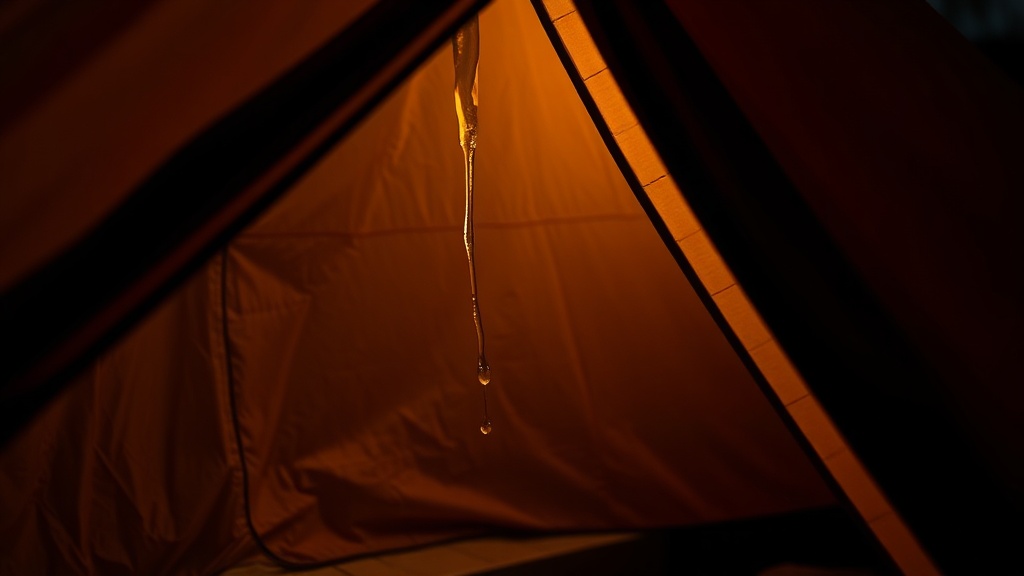
In wet conditions, failing tape seams don’t always produce a steady drip. More often they create a line of condensation on the interior surface that migrates downward and pools — which many hikers wrongly attribute to condensation from breath moisture. That’s a dangerous misread. Real condensation distributes relatively evenly on cold surfaces. A seam leak tracks the seam line precisely.
Real talk: if you’ve been blaming interior moisture on “condensation” every time you use your DCF tent in rain, there’s a reasonable chance at least one seam is already compromised.
DCF Seam Tape Failure vs. Other Tent Leak Causes — What You’re Actually Dealing With
Not every DCF tent leak is a seam tape issue. Knowing what you’re diagnosing before you start applying repair tape saves time and prevents making the problem worse.
| Leak Type | Location | Visual Sign | Fix | Risk if Ignored |
|---|---|---|---|---|
| Tape seam delamination | Seam edges, corners | Edge lift, light bleed | DCF-compatible repair tape | Full seam separation |
| DCF film pinhole | Panel face, anywhere | Tiny light point | Tenacious Tape patch | Low — very slow to enlarge |
| Stake loop grommet failure | Corner/edge attachment | Puckering, water wicking | Reinforce with patch + reseal | Structural failure in wind |
| Door zip wicking | Zipper coils | Water track along zip | Zipper lubricant + storm flap check | Zipper corrosion, worsening leak |
| Condensation (genuine) | Cold surfaces broadly | Diffuse moisture, no seam track | Ventilation improvement | None structural |
The table above matters because the fix for each failure type is different. Applying seam sealer meant for silnylon to a DCF tape failure doesn’t work — the chemistry is incompatible, and you’ll end up with a sticky, partially-adhered mess that complicates any future proper repair. I’ve seen this happen to experienced backpackers who grabbed the wrong product in a rush before a trip.
The Common Repair Advice That’s Actually Wrong
The most repeated recommendation online for fixing DCF seam tape failure is to apply Seam Grip WP or silicone seam sealer directly over the lifted tape. This is wrong, and here’s exactly why.
Seam Grip WP is a urethane-based adhesive sealant designed primarily for nylon and polyester fabrics — materials with surface texture and moderate chemical reactivity that allow the sealant to create a real bond. DCF’s polypropylene outer film is one of the least chemically reactive polymer surfaces in common use. Urethane sealants don’t bond to it permanently. They sit on top, appear to seal in dry conditions, then peel away under hydrostatic pressure or cold temperatures — often faster than the original tape failed.
That said, I understand why people reach for Seam Grip. It’s in every gear repair kit, it works on everything else, and the instructions don’t specify “not for DCF.” The gear community perpetuates this recommendation because it occasionally works well enough on tiny pinholes in the DCF film itself — not on delaminated seam tape. These are completely different failure modes requiring different treatments.
The correct approach for tape seam delamination is mechanical removal of the failed tape section and replacement with DCF-compatible repair tape — specifically 3M 8067 All Weather Flashing Tape, Gear Aid Tenacious Tape (clear, not the nylon-backed version), or manufacturer-supplied replacement tape if available. Clean the DCF surface with isopropyl alcohol first. Let it dry completely. Apply tape under firm, even pressure from center to edges. The bond strength increases significantly over 24-48 hours, so don’t stress-test it immediately after application.
Skipping the alcohol wipe is the number one failure mode in field repairs. The DCF surface collects body oil, sunscreen, and tent-floor grime that physically prevents tape adhesion even when the tape chemistry is correct.
Preventing DCF Seam Tape Failure Before It Starts
Prevention costs less than repair and far less than replacing a DCF shelter. Most premature tape seam failures trace back to avoidable storage and setup habits.
DCF tents should never be stored compressed for extended periods. Unlike nylon shelters, DCF doesn’t recover easily from long-term compression creasing — and those crease lines concentrate stress directly on bonded seam areas when the tent is pitched under tension. Store your DCF shelter loosely stuffed in a large breathable bag, not compressed in a stuff sack, when it’s in your garage or gear closet between trips.
UV exposure is the other major accelerant of tape adhesive degradation. The polypropylene film in DCF handles direct sun reasonably well, but the adhesive layer bonding the seam tape is far less UV-stable. Pitching your DCF tent in full sun for multi-day base camps — particularly at altitude where UV index is elevated — degrades seam tape adhesive measurably faster than moderate use in shade. REI’s tent repair guide covers general seam maintenance well, though it doesn’t fully address the DCF-specific chemistry issue.
Inspect seams annually at minimum — ideally before every multi-day trip. Catching a 2mm tape edge lift costs you ten minutes and a strip of repair tape. Catching it when rain is drumming on the tent at 2am above treeline costs you a wet sleeping bag, a miserable night, and potentially a safety situation if temperatures drop.
Thermal cycling is the silent killer here.
Field Repair Protocol When You’re Already in the Backcountry
You don’t always get to fix this at home before a storm hits. A functional emergency seam repair in the field requires the right materials in your kit and a specific sequence to execute under pressure.
Carry a small strip of Tenacious Tape clear on every trip — roughly 15cm is enough to address most acute seam failures. In the field, you won’t have isopropyl alcohol unless you specifically pack a few alcohol wipes. Use the driest, cleanest cloth you have to wipe the seam area. Body heat pressing is better than cold fingers — hold the tape repair firmly with palm pressure for 60 seconds minimum. Don’t try to patch over a wet seam in active rain; get the tent pitched on the dry side if possible, let the interior surface dry with whatever warmth you have, then apply.
A butterfly of duct tape over a failing seam from the outside is a genuine last resort. It reduces water ingress meaningfully by redirecting flow, even though the duct tape isn’t bonding to the DCF. This buys you the night. Fix it properly at home.
Practically speaking, the expeditions where I’ve seen DCF tent failures become genuine emergencies were always the ones where the hiker had noticed “something a bit off” with a seam weeks earlier and deferred the fix.
Frequently Asked Questions
Can you re-seam tape a DCF tent yourself, or does it need to go back to the manufacturer?
You can absolutely re-tape DCF seams yourself with the right tape — 3M 8067 or Tenacious Tape clear are the two most field-proven options. The key is surface preparation with isopropyl alcohol and sufficient cure time. Manufacturer returns are only necessary for structural seam failures involving the reinforcement webbing or bonded hardware attachments.
How long should DCF seam tape last before it needs attention?
In moderate use conditions — a few dozen nights per year, proper storage, mixed weather — quality DCF seam tape should hold for 3-5 seasons before showing edge lift. Heavy expedition use or UV-intense environments can accelerate failure to 1-2 seasons. Annual inspection is non-negotiable regardless of use frequency.
Is all DCF the same, or do some versions hold tape better than others?
Not all DCF is equal. Heavier-weight DCF (1.0oz/sqyd and above) has a more substantial film layer that provides better tape adhesion surface than ultralight 0.51oz DCF used in sub-400g shelters. The lightest DCF fabrics are the most performance-optimal and the most maintenance-demanding — a tradeoff that manufacturers don’t always communicate clearly at point of sale.
References
- REI Expert Advice: Tent Repair How-To
- Rokslide Forum — Field-tested gear discussion including DCF shelter maintenance
- Wilderness First Responder Field Manual, NOLS Wilderness Medicine, 7th Edition
- 3M Technical Data Sheet: 8067 All Weather Flashing Tape — Adhesion to Low-Surface-Energy Substrates
- Gear Aid Product Documentation: Tenacious Tape Application Guide for Ultralight Fabrics