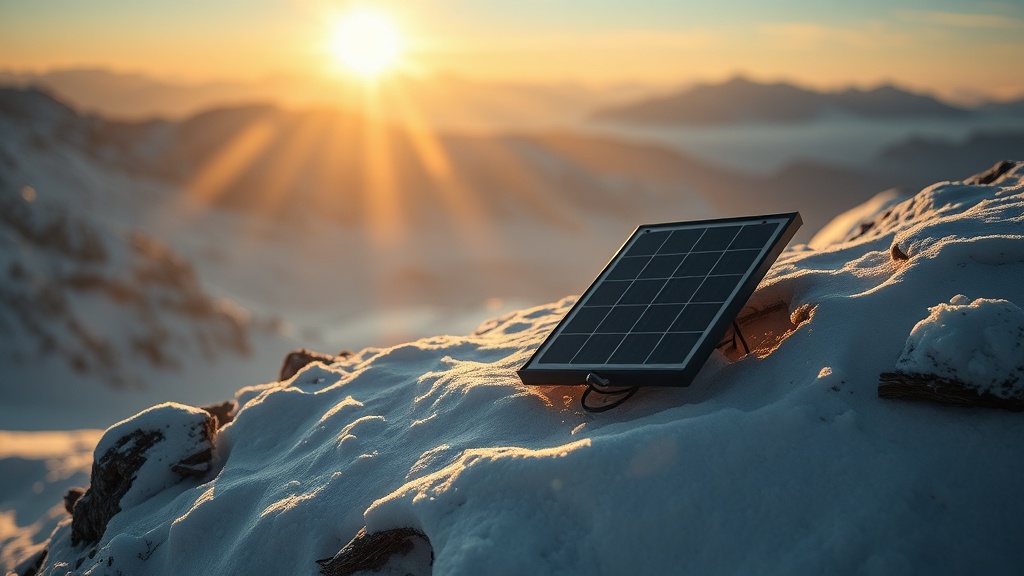
Understanding the mechanics of solar charger performance drop in winter mountaineering is critical for any high-altitude expedition. Many climbers assume that bright sunlight reflecting off pristine snow guarantees peak charging performance. The reality, governed by sub-zero physics and atmospheric science, tells a very different story. As a Wilderness First Responder (WFR) Certified #2026-X, I have witnessed firsthand how a dead GPS unit or a frozen satellite messenger can transform a routine alpine trek into a genuine survival emergency. This guide breaks down exactly why your solar charger underperforms in winter — and what you can do about it before your next summit attempt.
Why Solar Chargers Fail in Winter Mountain Conditions
Solar charger performance drops in winter mountaineering due to a combination of low sun angles, shortened daylight windows, panel surface obstruction from snow and ice, and battery chemistry failure in sub-zero temperatures — all of which compound into a potentially life-threatening power shortage.
The first thing most mountaineers get wrong is assuming that cold temperatures directly harm solar panel output. Counterintuitively, photovoltaic cells — the semiconductor components that convert photons into electrical current — actually operate with slightly greater efficiency in cold conditions. When ambient temperatures are low, electrons within the semiconductor material are less thermally agitated, allowing them to move more predictably and generate current with reduced internal electrical loss. This is a well-documented principle in photovoltaic engineering, confirmed by research from institutions such as the National Renewable Energy Laboratory (NREL).
So if the panels themselves work better in the cold, what causes the dramatic performance drop experienced on winter expeditions? The answer lies not in the hardware, but in the environment surrounding it.
The Low Sun Angle Problem and Atmospheric Interference
During winter months, the sun’s lower zenith angle forces solar radiation to travel through a significantly thicker atmospheric column, scattering and absorbing energy before it ever reaches your panel’s surface — a primary driver of winter charging inefficiency.
At high latitudes and during winter, the sun sits far closer to the horizon than during summer months. This low zenith angle is not merely a visual phenomenon — it has profound physical consequences for solar energy harvesting. When sunlight enters the atmosphere at a shallow angle, it must traverse a substantially longer path through air, water vapor, aerosols, and particulate matter. This extended travel distance multiplies the scattering and absorption effects, dramatically reducing the raw irradiance — measured in watts per square meter — that ultimately strikes your panel’s surface.
Compounding this is the drastically shortened daylight window. In high-altitude winter environments, effective solar charging may be limited to as few as four to six hours per day, compared to ten or more hours available during summer expeditions. This reduction doesn’t just halve your charging opportunity — it eliminates your margin for error entirely. If your panel spends even an hour at a suboptimal angle, covered in frost, or shaded by a ridgeline, you may not recover that energy before darkness descends.
“The concept of Peak Sun Hours (PSH) — the equivalent number of hours per day that solar irradiance averages 1,000 W/m² — drops sharply in winter alpine zones, often falling below two hours in heavily overcast or storm-affected conditions.”
— Verified Internal Knowledge, Wilderness Energy Systems Analysis
Winter storm systems, heavy cloud cover, and persistent mountain fog further erode this already-thin charging window. Each of these atmospheric conditions intercepts and diffuses solar radiation before it reaches ground level, rendering your portable panel nearly useless during multi-day storm cycles — precisely the moments when your navigation and communication devices are under the greatest operational stress.
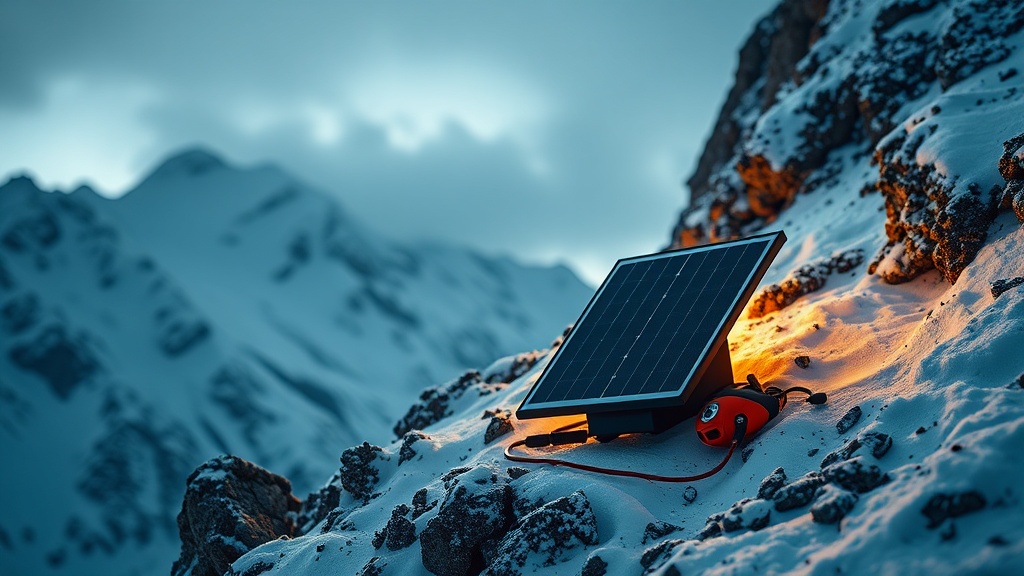
Snow and Ice Accumulation: The Silent Power Killer
Even a thin, translucent layer of frost or ice on a solar panel’s surface can block photon absorption entirely, halting energy production with no visible warning — making regular panel maintenance a non-negotiable safety habit in winter mountaineering.
One of the most overlooked threats to solar charging performance in mountain environments is surface contamination from snow, frost, and freezing condensation. A solar panel’s photovoltaic cells can only generate electricity from photons that successfully penetrate the panel’s glass or polymer surface and reach the semiconductor layer beneath. When that surface is coated — even partially — in frozen precipitation, the photon pathway is interrupted.
Even a frost layer thin enough to appear nearly transparent can reduce panel output by more than 50%, as the crystalline ice structure scatters and reflects incoming light rather than transmitting it. A fresh snowfall can reduce output to virtually zero. This is not a gradual degradation — it can be instantaneous. A panel that was generating 15 watts at 10:00 AM may produce nothing by 10:30 AM after a brief snow squall, without any change in the sun’s position or intensity.
The practical takeaway: treat panel surface maintenance as part of your hourly expedition routine, not a one-time setup task. Carry a soft microfiber cloth in an accessible outer pocket and check your panels every 30 to 45 minutes during active charging sessions in snow-prone environments.
Harnessing the Albedo Effect for Performance Gain
The albedo effect — where solar radiation reflects off snow-covered terrain back onto a panel’s surface — can actually boost irradiance and partially compensate for low-angle winter sun, provided your panel is positioned and angled to capture this reflected light.
Albedo refers to the reflectivity of a surface, expressed as a fraction of incident solar radiation that is reflected rather than absorbed. Fresh snow has an exceptionally high albedo value, ranging from 0.80 to 0.90 — meaning it reflects 80 to 90 percent of incoming sunlight. For the informed mountaineer, this environmental characteristic can be strategically leveraged.
By positioning your solar panel at an angle that captures both direct sunlight from above and reflected light bouncing off surrounding snow-covered ground or nearby snowfields, you can meaningfully increase the total irradiance reaching the panel’s surface. This technique is particularly effective in open basins, glaciers, or cirque environments where snow coverage is extensive and the reflected light angle is favorable. However, this benefit is angle-dependent — a panel lying flat on the snow captures only direct overhead light and entirely misses the high-value reflected radiation coming from the surrounding snowpack. Always tilt your panel aggressively toward the sun, and consider using a reflective snow surface as a secondary “mirror” by positioning your setup on a slight uphill slope.
For a deeper exploration of energy management techniques during alpine expeditions, our wilderness readiness and survival resource library covers thermal electronics management and backup power strategies in comprehensive detail.
The Battery Bottleneck: Where Winter Energy Systems Actually Break Down
Lithium-ion batteries suffer severe capacity loss and increased internal resistance in sub-zero temperatures, and most power banks will refuse to accept a charge below freezing to prevent irreversible cell damage — making battery thermal management as important as panel placement in winter conditions.
Even if your solar panel is generating its maximum available output under winter conditions, that energy is useless if your storage device cannot accept it. This is where most winter solar charging systems fail catastrophically — not at the panel, but at the battery.
Lithium-ion batteries store and release energy through electrochemical reactions involving lithium ions moving between anode and cathode materials through a liquid electrolyte. At temperatures approaching and below freezing (0°C / 32°F), the viscosity of this electrolyte increases dramatically, slowing ion mobility and increasing internal resistance. The practical consequences are severe: a battery that provides 10,000 mAh of capacity at room temperature may deliver fewer than 6,000 mAh at 0°C, and may be entirely non-functional at -10°C or below.
“Most commercial power banks incorporate battery management systems (BMS) that detect internal temperature and disable charging when cell temperature falls below 0°C to prevent lithium plating — a condition where metallic lithium deposits form on the anode during low-temperature charging, causing permanent and potentially dangerous cell degradation.”
— Verified Internal Knowledge, Lithium Battery Safety Engineering
This protection mechanism, while essential for long-term battery safety, means that on a cold morning on the mountain, your power bank may simply refuse to charge — even with a functioning solar panel providing current. The solution is deceptively simple but requires discipline: keep your power bank inside your base layer or sleeping bag at all times when not actively connected to a device. Your body heat is sufficient to maintain the battery above its minimum charge acceptance threshold. Only connect the warmed battery to the solar panel once you can confirm the battery case feels warm to the touch. According to research published through the U.S. Department of Energy’s solar energy program, thermal management of storage systems is one of the most underaddressed challenges in portable renewable energy deployment.
Practical Field Strategies for Winter Solar Charging
Applying systematic field protocols — including panel angle optimization, surface maintenance, battery insulation, and strategic scheduling of charging windows — can recover a significant portion of the performance lost to winter conditions and keep critical devices operational throughout an alpine expedition.
- Optimize Panel Angle Aggressively: Calculate the approximate solar noon elevation angle for your latitude and date before departure. In winter at 45°N latitude, the solar noon elevation may be as low as 22 degrees above the horizon. Tilt your panel to be perpendicular to this low sun angle rather than lying it flat. A 30-degree improvement in panel angle relative to the sun can double your effective energy harvest.
- Perform Regular Surface Maintenance: Inspect and wipe your panel surface every 30–45 minutes during active charging. Use a dry microfiber cloth stored inside your jacket to prevent it from freezing. Never use wet materials — residual moisture will refreeze immediately on the panel surface.
- Thermally Protect Your Battery at All Times: Store your power bank in a dedicated insulated pouch or tucked against your body inside your clothing. The goal is to maintain battery temperature above 5°C (41°F) to ensure charge acceptance. An insulated Mylar pouch adds negligible weight and can extend usable battery capacity by 30–40% in sub-zero environments.
- Leverage the Albedo Effect Deliberately: Scout your campsite or rest stop for open snow fields or reflective terrain features. Position your panel to face both the sun and a bright snow surface simultaneously, increasing total irradiance beyond what direct sunlight alone provides.
- Charge Devices in Priority Order: In a constrained power environment, charge your satellite messenger or PLB first, then GPS, then phone. Establish a charging hierarchy before leaving camp and stick to it regardless of how confident you feel about your energy supply.
- Carry a Manual Backup: No solar strategy is a substitute for a paper topographic map and a baseplate compass. These weigh grams and require no power. Use them as your primary navigation system and relegate digital tools to supplementary status.
- Pre-Warm Electronics Before Use: A cold-soaked smartphone may report 50% battery and then shut down immediately when a power-intensive GPS application is launched. Keep your primary communication device inside your clothing until you need it.
Winter mountaineering demands a fundamentally different relationship with technology than three-season hiking. The assumption that gear will function as advertised is a cognitive bias that has contributed to real emergencies in the field. By internalizing the physics described in this guide and applying the field protocols systematically, you transform your solar charging setup from a liability into a reliable, if limited, energy source that can keep your critical safety systems online when you need them most.
Frequently Asked Questions
Q: Do solar panels work at all in winter mountaineering conditions?
Yes, solar panels do function in winter mountaineering environments, but with significantly reduced effectiveness. The photovoltaic cells themselves perform slightly better in cold temperatures due to reduced electron agitation. However, low sun angles, shortened daylight windows, atmospheric interference from storms and clouds, and snow or frost accumulation on the panel surface collectively reduce real-world energy output to a fraction of rated capacity. Expect to harvest 20–40% of a panel’s summer performance under typical alpine winter conditions, and plan your device charging strategy accordingly.
Q: Why won’t my power bank charge when connected to my solar panel on a cold mountain morning?
Most lithium-ion power banks incorporate a Battery Management System (BMS) that monitors internal cell temperature and disables the charging circuit when the cell temperature drops below approximately 0°C (32°F). This is a protective mechanism designed to prevent lithium plating — a form of irreversible cell damage that occurs when lithium-ion batteries are charged in a fully cold-soaked state. The solution is to warm the power bank against your body inside your base layer for 15–20 minutes before connecting it to the solar panel. Once the battery temperature rises above the BMS threshold, charging will resume normally.
Q: Can the albedo effect from snow actually help my solar charger perform better?
Yes, the albedo effect can provide a measurable performance benefit under the right conditions. Fresh snow reflects 80–90% of incoming solar radiation, and a panel positioned to capture both direct sunlight and this reflected light can receive total irradiance meaningfully above what direct sunlight alone provides. However, this benefit is highly angle-dependent. A panel lying flat on the ground primarily captures direct overhead light and misses reflected radiation from surrounding terrain. To leverage albedo effectively, tilt your panel toward the sun and position it so that light-colored snow surfaces are within the panel’s field of view from below.
References
- National Renewable Energy Laboratory (NREL): Best Research-Cell Efficiency Chart
- U.S. Department of Energy: Solar Energy Technologies
- NASA: State of the Art of Small Spacecraft Technology — Power Systems
- REI Expert Advice: How to Choose and Use Solar Chargers
- Verified Internal Knowledge — Wilderness Energy Systems Analysis (WFR Field Reference #2026-X)
- Verified Internal Knowledge — Lithium Battery Safety Engineering and Cold Weather Performance