
Mastering condensation management in bivy sacks below freezing is one of the most underestimated survival skills in winter wilderness travel. Mountaineers, cold-weather campers, and emergency responders alike face the same brutal reality: the moisture your body produces overnight can silently degrade your sleep system’s insulation, turning a well-planned bivouac into a potentially life-threatening situation. Understanding the underlying physics — and applying proven mitigation strategies — is the difference between waking up rested and waking up dangerously wet in sub-zero conditions.
The Physics Behind Condensation in Sub-Freezing Bivy Environments
Condensation inside a bivy sack occurs when warm, moist air from the body meets the cold, semi-permeable or impermeable fabric wall, dropping to the dew point and transitioning into liquid water or frost. In sub-freezing environments, this process is accelerated and far more damaging to insulation loft.
Every human being releases moisture continuously during sleep — through skin respiration, perspiration, and most significantly, through breathing. Inside the confined envelope of a bivy sack, this moisture has nowhere to go. As the warm, vapor-laden air migrates outward and contacts the cold fabric wall, it reaches its dew point — the temperature at which air can no longer hold its moisture in vapor form. The result is condensation on the inner surface of the bivy.
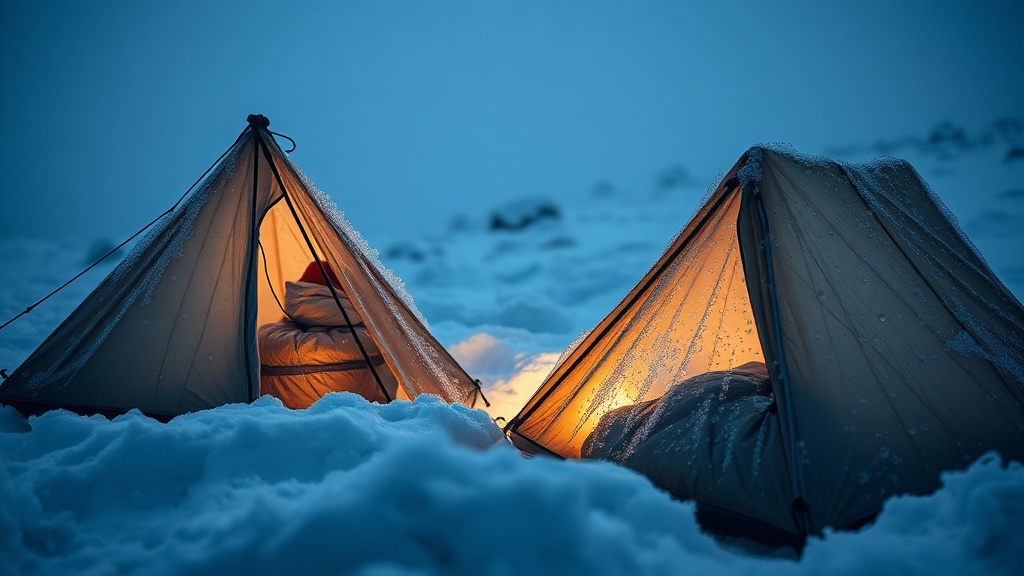
In temperatures below freezing, this process takes a particularly destructive form. Rather than simple liquid condensation, moisture often freezes directly onto the inner fabric wall, forming a layer of frost. This frost accumulation is deceptively dangerous. Throughout the night, as your body heat fluctuates or you shift position and create brief contact between your sleeping bag and the bivy wall, that frost begins to melt. The resulting meltwater wicks directly into your sleeping bag’s insulation — whether down or synthetic — dramatically reducing its thermal efficiency at the exact moment you need it most.
“In sub-freezing temperatures, moisture frequently freezes into frost on the inner wall of the bivy, which can later melt and compromise the insulation of the sleeping bag — a cascade failure that is silent, incremental, and potentially fatal in severe conditions.”
— Verified Field Knowledge, Wilderness First Responder Practice
According to Wikipedia’s entry on dew point, the temperature differential required to trigger condensation depends on relative humidity and the ambient temperature — two variables that are almost always unfavorable inside a sealed bivy on a cold night. Understanding this thermodynamic relationship is foundational to any serious cold-weather survival strategy.
Why Breathable Fabrics Fail in Extreme Cold
Waterproof-breathable membranes like GORE-TEX and eVent rely on a vapor pressure gradient to move moisture outward, but in extreme cold, frost can physically block the membrane’s microporous structure, effectively rendering the fabric non-breathable and trapping moisture inside.
Many winter campers mistakenly believe that investing in a premium waterproof-breathable membrane — such as GORE-TEX or eVent — will solve their condensation problem entirely. While these technologies represent the best available engineering for moisture vapor transmission, they operate on a principle that becomes increasingly compromised as temperatures plummet.
Breathable membranes function by allowing water vapor molecules (which are smaller than liquid water droplets) to pass through microscopic pores from the warmer, higher-pressure interior to the cooler, lower-pressure exterior. However, in sub-freezing conditions, two compounding problems arise. First, the vapor pressure differential that drives moisture transmission is significantly reduced at low temperatures — the driving force behind breathability simply weakens in extreme cold. Second, and more critically, frost crystals can physically occlude the membrane’s pores from the inside, creating a solid barrier that blocks further vapor transmission entirely.
This frost-blocking phenomenon is why even a $600 GORE-TEX bivy can leave you drenched by morning in truly harsh alpine conditions. The fabric’s design limitations are not a flaw — they are a physical reality of operating at the extreme margins of its intended performance envelope. Recognizing this limitation is essential for any practitioner of serious cold-weather survival. For a broader perspective on gear performance in extreme environments, our deep-dive resources on wilderness readiness and survival equipment provide critical context for making informed gear decisions.
Primary Sources of Moisture: Identifying the Enemy
Exhaled breath is the single largest contributor to moisture buildup inside a bivy sack, producing far more water vapor per hour than skin perspiration alone. Eliminating or redirecting breath moisture is the highest-leverage intervention available to any winter camper.
To manage condensation effectively, you must first understand where the moisture is actually coming from. There are two primary sources:
- Respiratory moisture: Exhaling inside a bivy sack is the leading cause of moisture buildup. The average adult exhales approximately 200–400 ml of water vapor per hour during sleep. In a fully enclosed bivy, this moisture has nowhere to go and rapidly saturates the internal air, dramatically accelerating condensation on the fabric walls.
- Insensible perspiration: Even when you are not actively sweating, your body continuously releases moisture through your skin. This insensible perspiration migrates outward through your clothing and sleeping bag insulation, eventually reaching the bivy wall. While less dramatic than breath moisture, it accumulates steadily over an 8-hour sleep cycle and can saturate down insulation over multiple consecutive nights.
- External moisture ingress: In certain conditions — particularly in maritime alpine environments or during freeze-thaw cycles — external humidity and condensation can migrate inward through the bivy fabric, adding to the internal moisture load from outside.
Mechanical Ventilation: The First Line of Defense
Leaving the bivy zipper slightly open near the face creates a critical airflow pathway that allows moist, warm air to escape before reaching its dew point on the cold fabric. This single adjustment can reduce internal humidity by a significant margin without meaningfully increasing heat loss.
The most immediately actionable strategy for managing condensation is mechanical ventilation — deliberately creating an opening in the bivy to allow air exchange. Keeping your mouth and nose positioned outside or near the face opening of the bivy redirects the majority of your breath moisture directly into the environment rather than into the bivy’s interior airspace.
In practice, this means:
- Leaving the head opening zipper cracked by 2–4 inches, even in severe cold. The heat penalty for this small opening is minimal compared to the insulation degradation caused by a wet sleeping bag.
- Positioning yourself so that your face is near — but not inside — the bivy opening, allowing exhaled breath to escape while your body and sleeping bag remain sheltered.
- Avoiding the temptation to pull the bivy completely closed over your face in response to cold air. This instinct is understandable but counterproductive, as it dramatically accelerates moisture accumulation.
- In wind or precipitation, using a hood or balaclava to protect exposed facial skin rather than sealing the bivy — maintaining airflow while protecting against the elements.
The Vapor Barrier Liner: A Professional-Grade Solution
A Vapor Barrier Liner (VBL) is a non-breathable inner layer worn directly against the skin to stop insensible perspiration at its source, preventing moisture from ever migrating into sleeping bag insulation or reaching the bivy wall. It is the most effective tool available for multi-night extreme cold expeditions.
For extended cold-weather operations — mountaineering expeditions, winter survival scenarios, or multi-day bivouacs below -20°C (-4°F) — mechanical ventilation alone is insufficient. This is where a Vapor Barrier Liner (VBL) becomes an indispensable tool. A VBL is a non-breathable layer — typically a lightweight polyurethane or coated nylon sack — worn directly against the skin or over a thin base layer. By creating an impermeable barrier between your skin and your sleeping bag, it stops insensible perspiration before it can migrate into your insulation.
The counterintuitive principle behind the VBL is that once the air layer immediately adjacent to your skin becomes saturated with moisture, your body essentially stops producing insensible perspiration in that microzone. The result is that your sleeping bag and bivy remain dramatically drier over multiple nights, maintaining their designed insulation value throughout an expedition. Research published in wilderness medicine literature, including resources cited by the Wilderness Medical Society, supports the use of vapor management strategies as a core component of cold-injury prevention protocols.
Key considerations for VBL use include:
- Expect a brief initial sensation of clamminess as the microclimate against your skin stabilizes — this dissipates within 15–20 minutes.
- A VBL is most effective when combined with a thin moisture-wicking base layer, preventing direct contact between the non-breathable material and bare skin.
- VBLs are particularly valuable for down sleeping bags, which lose insulative capacity far more rapidly than synthetic fills when wet.
- Commercial VBL options include dedicated products from Integral Designs and homemade solutions using contractor-grade polyethylene bags — both are field-proven approaches.
Strategic Site Selection to Minimize Moisture Load
Camping in low-lying frost pockets — topographic depressions where cold, humid air pools overnight — significantly increases the external moisture load on a bivy. Selecting elevated, wind-exposed terrain with good drainage can measurably reduce condensation formation from the outside in.
Condensation management does not begin when you climb into your bivy — it begins when you select your campsite. Cold air is denser than warm air and drains downhill overnight, pooling in valleys, depressions, and areas near standing water. These areas, known among experienced mountaineers as frost pockets, consistently exhibit higher relative humidity and colder overnight temperatures than the surrounding terrain.
Effective site selection protocols for minimizing bivy condensation include:
- Elevation: Even a modest gain of 10–30 meters above a valley floor can place you above the cold air drainage layer, resulting in measurably warmer and drier overnight conditions.
- Drainage: Select ground that slopes slightly to ensure any ground moisture or snowmelt drains away from your sleeping position rather than pooling beneath the bivy.
- Airflow: Moderate air movement assists in evaporating surface moisture from the bivy exterior. A position with gentle airflow — not wind exposure — is preferable to a perfectly sheltered, stagnant hollow.
- Distance from water: Avoid camping within 60 meters of streams, lakes, or wet meadows, which generate significant nocturnal humidity as temperatures drop.
Morning Frost Management: Critical Field Protocol
When frost has formed on the inner bivy wall overnight, the critical window for damage control is immediately upon waking — before body heat from re-entering the bag or ambient daytime warming melts the frost into liquid water that can saturate insulation.
Even with perfect ventilation and VBL use, some frost accumulation on the inner bivy wall is unavoidable in truly severe cold. The field protocol for handling this effectively is as follows:
- Upon waking, do not immediately re-compress your sleeping bag. Allow the bivy interior to cool slightly by opening the face seal, which firms up any frost and makes it easier to remove without converting to liquid.
- Turn the bivy inside out and vigorously shake and beat the frost free from the interior surface. In temperatures below -10°C (14°F), frost will shatter and flake away cleanly rather than melting into the fabric.
- If sunlight is available, lay the bivy out in direct sun for 15–20 minutes before packing — solar radiation can sublimate residual frost directly into vapor without passing through the liquid phase, leaving the fabric dry.
- Never pack a frost-covered bivy tightly against your sleeping bag, as the pressure and residual body heat will melt the frost into the insulation during transport.
Frequently Asked Questions
Q: Is a GORE-TEX bivy sack enough to prevent condensation in temperatures below -20°C (-4°F)?
No. While GORE-TEX and similar waterproof-breathable membranes provide excellent moisture vapor transmission in moderate conditions, their pores can become blocked by frost in extreme cold, dramatically reducing breathability. In temperatures below -20°C, a GORE-TEX bivy should be considered a moisture-resistant shell rather than a condensation solution. Mechanical ventilation and a Vapor Barrier Liner are essential supplements at these temperatures.
Q: Will using a Vapor Barrier Liner make me feel clammy or uncomfortable during sleep?
There is an initial adjustment period of approximately 15–20 minutes during which the microclimate between the VBL and your skin will feel damp. However, once that thin air layer becomes saturated, insensible perspiration largely stops in that zone and the sensation stabilizes. Most experienced cold-weather practitioners report that the comfort trade-off is entirely acceptable given the significant benefit of keeping their sleeping bag dry across multiple consecutive nights.
Q: How do I know if my sleeping bag has been compromised by bivy condensation overnight?
The primary indicators of moisture-compromised insulation are a noticeable reduction in loft (the bag will feel flatter and less puffy than when dry), a damp or clammy sensation when pressing the insulation, and a marked increase in how cold you feel despite the bag being rated for current temperatures. Down insulation is particularly susceptible — even a 10–15% moisture content by weight can reduce a down bag’s thermal rating by 30% or more, creating a genuine survival hazard in severe conditions.
References
- Wikipedia: Dew Point — Thermodynamic principles of condensation
- GORE-TEX Official: Waterproof-Breathable Membrane Technology
- Wilderness Medical Society: Cold Injury Prevention and Wilderness Medicine Standards
- Verified Internal Knowledge: Condensation mechanics in confined bivy environments at sub-freezing temperatures — WFR Field Practice Documentation
- Verified Internal Knowledge: Vapor Barrier Liner efficacy in extreme cold expedition contexts — Field-tested protocol summary